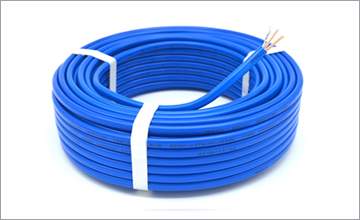
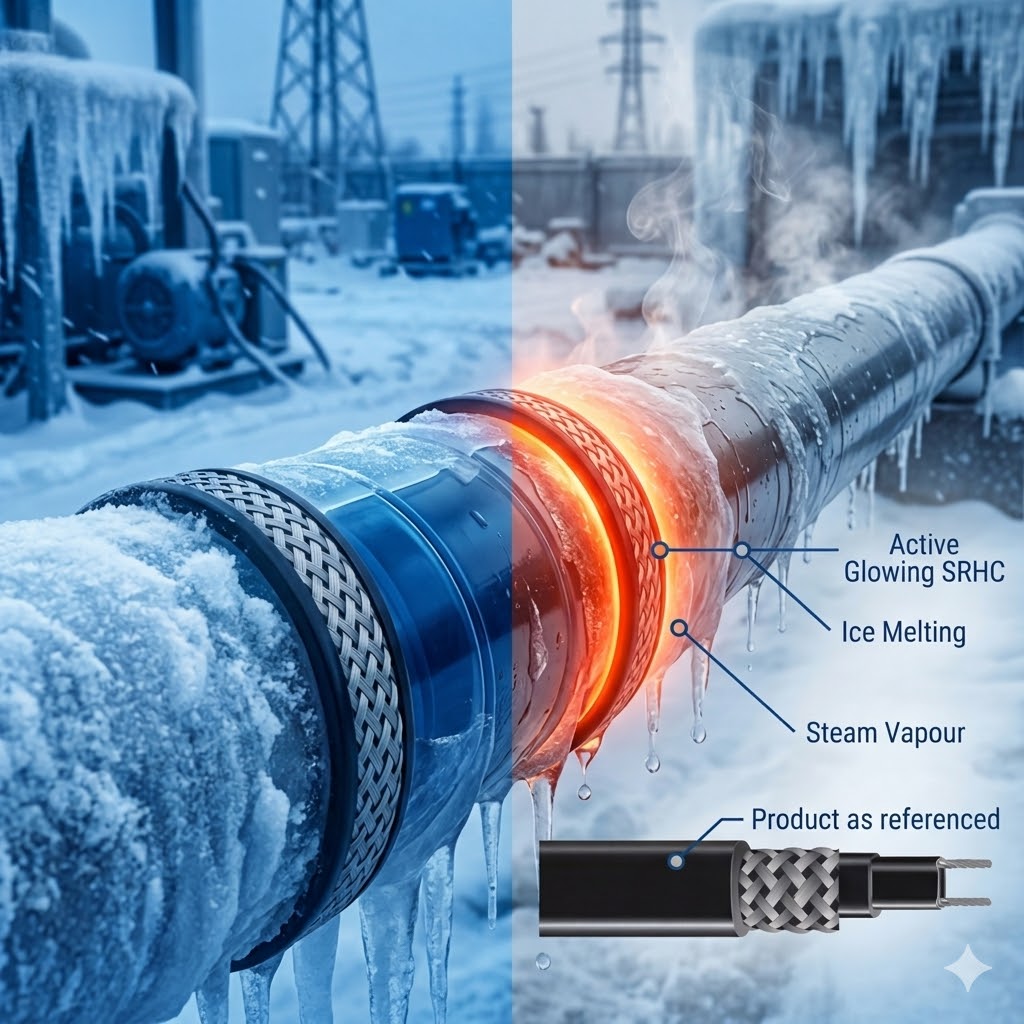
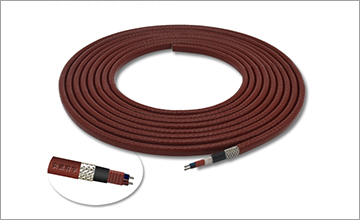
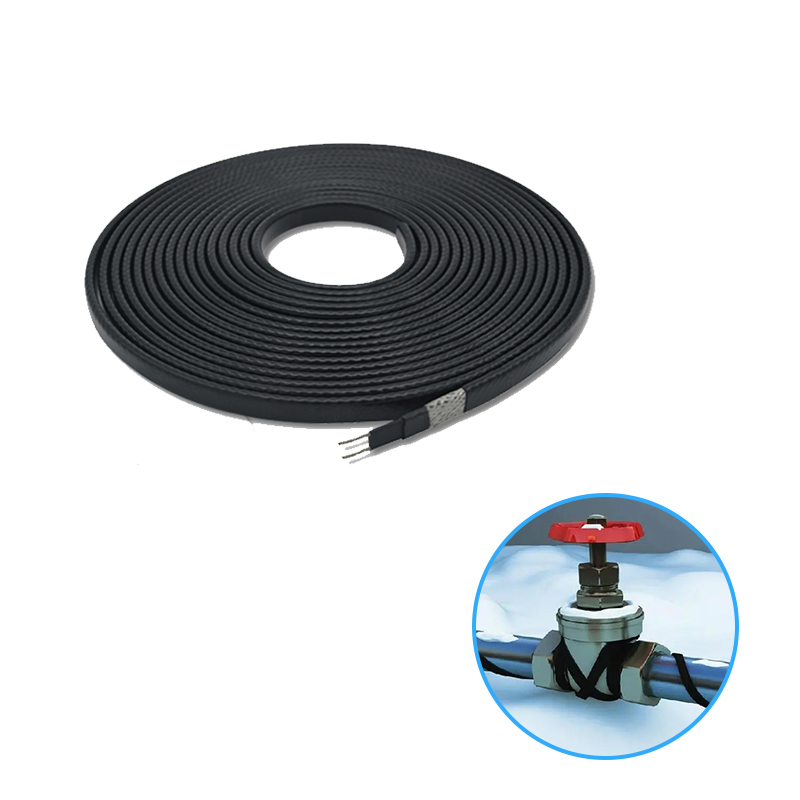
When designing pipeline freeze protection, roof deicing and pavement snow melting systems, engineers must choose between self-regulating and constant wattage heat trace cable. Both types belong to Trace heating cable and electric heating cable series, but they have huge differences in working principles, installation limits, safety performance and applicable scenarios. This full comparison guide helps engineers make accurate project selections.
Self-regulating heat trace cable features
Self-regulating heat trace cable adopts conductive polymer core material, which can automatically adjust conductivity and heat output according to ambient temperature. When the temperature drops, heat output increases; when the temperature rises, power output decreases automatically.
✅ Core advantages: Built-in anti-overheating function, supports on-site cutting, simple installation, low failure rate, high safety for residential projects
✅ Typical applications: Residential
pipe heating cable for water pipeline anti-freezing, gutter heating cable for roof deicing
❌ Limitation: Cannot meet high-temperature long-term process temperature maintenance requirements for industrial projects
Constant wattage heat trace cable features
Constant wattage heat trace cable outputs fixed stable heat per meter after power-on, with heat output unaffected by ambient temperature changes. It is designed for high-power and high-stability industrial heating scenarios.
✅ Core advantages: Ultra-stable heat output, high power density, suitable for long-term continuous high-temperature operation
✅ Typical applications: Industrial high-temperature pipeline process tracing, large-area commercial snow melting cable systems
❌ Limitation: Cannot be cut arbitrarily on site, must be matched with professional thermostat control to avoid overheating risks
Side-by-side performance comparison
1. Heat output mode: Self-regulating (intelligent adjustment) VS Constant wattage (fixed output)
2. On-site cutting: Self-regulating (supported) VS Constant wattage (not allowed)
3. Main application: Residential freeze protection VS Industrial high-temperature process heating
4. Safety performance: Self anti-overheating VS Dependent on external thermostat
5. Installation flexibility: Field cuttable VS Fixed length customization
How to make the right choice for your project
Choose
self-regulating heat trace cable if you need flexible installation, DIY-friendly operation, and basic freeze protection for residential water pipes, household gutters and ordinary commercial facilities. It is the most cost-effective and safe option for daily anti-freeze demands.
Choose constant wattage heat trace cable if your project requires long-term high-temperature heat preservation, stable high-power output, and large-area snow melting scenarios such as factory pavements and commercial plazas. Industrial pipeline heat tracing for oil, chemical and gas transmission also requires constant wattage products.
Supporting system matching tips
No matter which type of Trace heating cable you choose, matching intelligent thermostats and temperature sensors can effectively reduce power consumption and extend cable service life. For buried snow melting cable and outdoor
gutter heating cable, high weather resistance accessories are essential to adapt to harsh outdoor environments. For indoor heating projects, cooperate with a professional Floor heating manufacturer to obtain matched electric heating mats for floors.
FAQ
Q1: Which cable type saves more electricity?
A: Self-regulating
heat trace cable automatically reduces power in high temperature environments, offering better energy-saving performance for intermittent use scenarios.
Q2: Can constant wattage heat trace cable be used for residential pipe heating?
A: It is usable but not recommended. It requires strict temperature control and professional installation, with higher comprehensive costs than self-regulating types.
Q3: Do both cable types have explosion-proof grades?
A: Yes, industrial explosion-proof grades are available for both types to meet hazardous location construction standards.
Our factory provides both self-regulating and constant wattage heat trace cable and Trace heating cable, as well as full-series pipe heating cable, gutter heating cable, snow melting cable and electric heating mats for floors. As a professional
Floor heating manufacturer, we offer customized heating solutions for different project scenarios.